Herbert Zhenghao Zhou | 周正浩

📍 New Haven, CT
📧 herbert.zhou@yale.edu
🌗 computational psycholinguist
Welcome! I am a penultimate-year PhD student in the Department of Linguistics at Yale University. I am deeply grateful to be advised by Robert Frank and Tom McCoy. I am an active member in the CLAY Lab. I graduated from Washington University in St. Louis in 2022 with a B.S. in Computer Science & Mathematics and PNP (a philosophy-centric cognitive science program). I grew up in Shanghai, China.
What is the shared basis of intelligence in natural and artificial systems? I approach this question through the language lens. My research interests are at the intersection of computational linguistics and psycholinguistics, with the goal of understanding the mechanisms of how humans and AI models incrementally represent and process human language, respectively. I am particularly interested in the algorithmic / mechanistic level interpretability: to what extent do AI models implement the processing mechanisms we find in humans, and to what extent can knowledge from AI models inform us about human cognition. I use methods from targeted behavioral evaluation, mechanistic interpretability, and human psycholinguistic experiments to study insights from the bidirectional interactions between cognitive science and AI/NLP. I am also interested in other cognitively plausible and interpretable models of sentence processing, in particular dynamical system models such as the Gradient Symbolic Computation framework and the Dynamic Field Theory. See more details in the Research tab.
Outside academia, I enjoy books 📖 and coffee ☕️ (you can always find me in cafés over the weekends), music 🎼 and museums 🏛️ (I sing in the Contour A Cappella group at Yale), biking 🚲 and hiking ⛰️ (but never professional, as I enjoy the casual flow).
news
| Oct 22, 2026 | New preprint on ArXiv📜! Check out our findings on how indirect evidence helps LMs to learn to generalize across different families of syntactic constructions. This is also my first work as a supervisor, and congrats to William Dai who completed a(nother) first-author project during his undergrad 🙇♂️! |
|---|---|
| Oct 21, 2026 | I will be attending EMNLP 2026 @ Budapest during Oct 22-30 🌅! I will give an oral presentation on our work on causal interventions on continuous variables, with which I demonstrate causal evidence for the strengths and limitations of steering vectors on adapting-in-context in LMs, sheding light on the broader connections between human structural priming and LM in-context learning 🌖! |
| Sep 27, 2026 | Excited to give two invited talks at the Computational Sentence Procesing Lab at UMass Amherst (Oct 16) and the ANCOR Research Talks at Brown University (Nov 6) ⚙️🧠! |
| May 01, 2026 | I am giving an invited talk at UMD Computational Cognitive Science group on May 5th 🧑🏫. Saying hi to my Maryland friends! |
| Apr 25, 2026 | One paper accepted to CoNLL🎉! We developed a fine-grained parsing tool to detect filler-gap dependencies and gap sites. Applying to CHILDES reveals large-scale distributional patterns that could inform children’s FGD acquisition and linguistic generalization in BabyLMs. I will present this work early July in both CoNLL and SCiL in San Diego 🌊~ |
selected publications
-
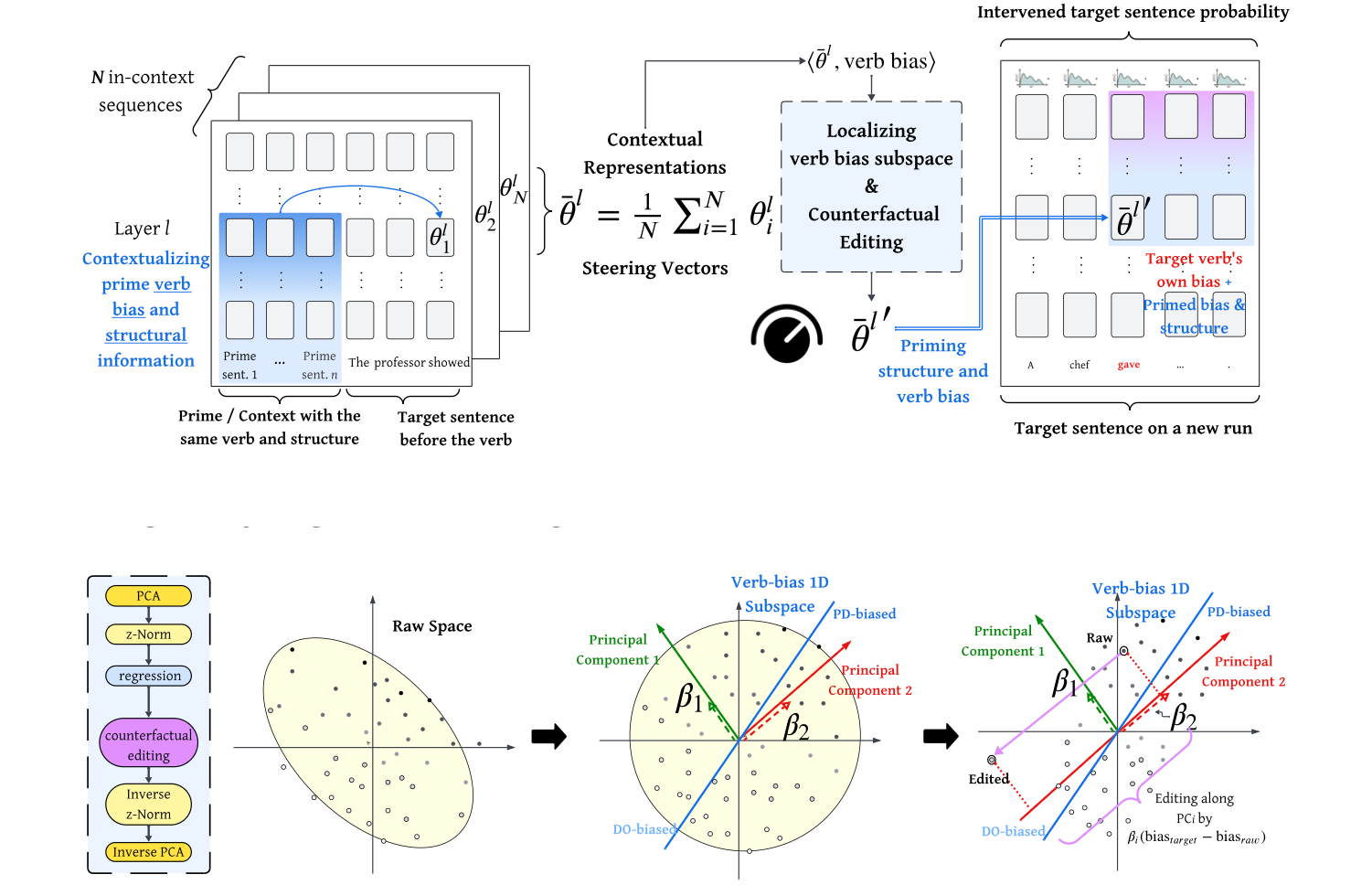 Causal Interventions on Continuous Variables: A Case Study on Verb Bias in Steering Vectors for In-Context LearningIn Proceedings of the 2026 Conference on Empirical Methods in Natural Language Processing (EMNLP), Oct 2026Main paper; Preprint available at arXiv:2605.29971 [cs.CL]
 -
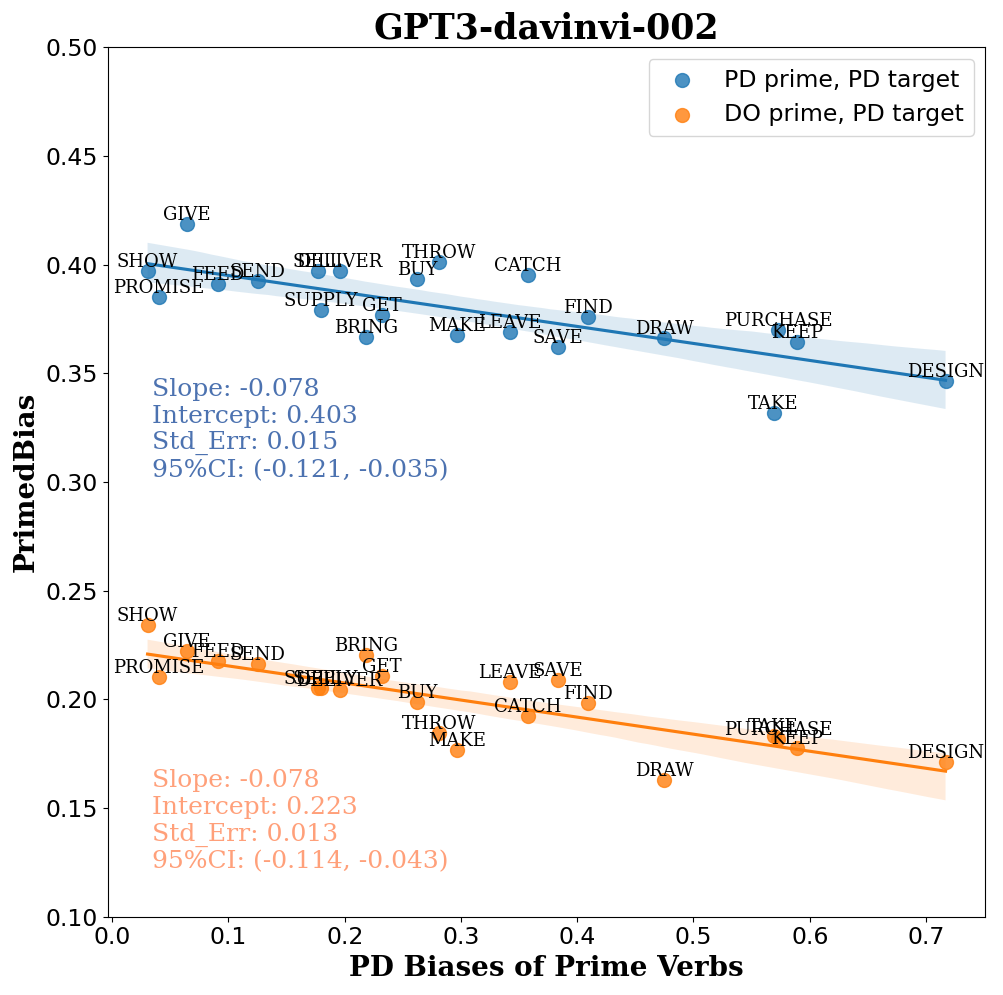 Is In-Context Learning a Type of Error-Driven Learning? Evidence from the Inverse Frequency Effect in Structural PrimingIn Proceedings of the 2025 Conference of the Nations of the Americas Chapter of the Association for Computational Linguistics: Human Language Technologies (Volume 1: Long Papers), Apr 2025


